
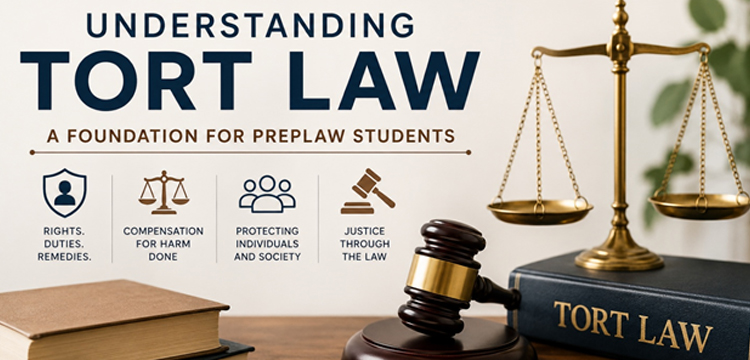
Tort law is one of the most important building blocks in legal studies and a core topic for any PrepLaw student. It deals with civil wrongs—situations where one person’s actions cause harm or loss to another, and the law steps in to provide a remedy.
Unlike criminal law, which punishes wrongdoing on behalf of the state, tort law focuses on compensation for the victim. The main goal is not punishment, but to restore the injured party to the position they were in before the harm occurred.
What is a Tort?
A tort is a wrongful act—intentional or accidental—that causes harm to another person. Common examples include negligence, defamation, trespass, and nuisance.
For instance, if a driver ignores traffic signals and causes an accident, the injured party may bring a negligence claim under tort law.
Key Elements of Tort Law
To succeed in a tort claim, a claimant generally must prove three essential elements:
- Duty of Care
The defendant must have had a legal responsibility to act carefully toward the claimant. - Breach of Duty
The defendant failed to meet the required standard of care. - Damage or Harm
The claimant suffered actual loss or injury as a result of the breach.
These three elements form the foundation of most negligence cases, which are heavily tested in PrepLaw assessments.
Types of Torts
Torts are broadly categorized into three groups:
- Negligence: Failure to take reasonable care, leading to harm.
- Intentional Torts: Deliberate actions like assault or defamation.
- Strict Liability Torts: Liability without fault, often in cases involving dangerous activities.
Understanding these categories helps students quickly identify legal issues in exam scenarios.
Remedies in Tort Law
The primary remedy in tort cases is damages, which is monetary compensation awarded to the injured party. In some cases, courts may also grant:
- Injunctions (orders to stop certain actions)
- Restitution (restoring property or position)
Why Tort Law Matters for PrepLaw Students
Tort law is frequently tested in legal entrance exams because it evaluates analytical thinking and issue-spotting skills. Students are expected to apply legal principles to real-life scenarios rather than just memorizing definitions.
A strong grasp of tort law also builds a foundation for advanced legal subjects like contract law, constitutional law, and criminal liability.
For PrepLaw students, mastering tort law is not just about passing exams—it is about understanding how the law protects individuals in everyday life. By focusing on core principles and practicing scenario-based questions, students can build both confidence and competence in this essential area of law.