
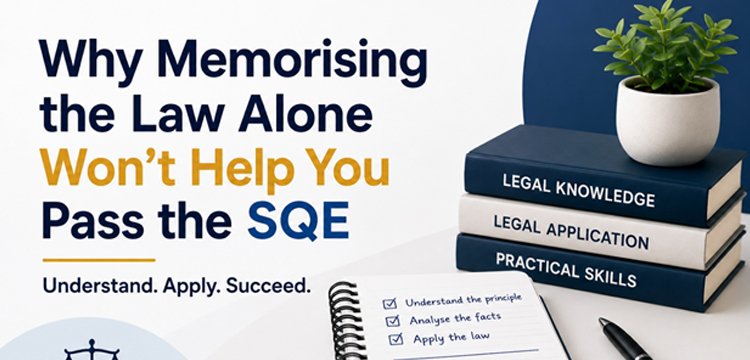
Many students begin SQE preparation believing that success depends mainly on memorising large amounts of legal information. While understanding legal principles is important, memorisation alone is rarely enough to perform well in the exam. The SQE is designed to test how effectively candidates can apply legal knowledge in practical situations, not simply recall textbook definitions.
The Solicitors Qualifying Examination, introduced by the Solicitors Regulation Authority, focuses heavily on functioning legal knowledge. This means candidates must understand how the law operates in realistic scenarios and demonstrate the ability to make sound legal judgments under pressure. Students who rely entirely on memorisation often struggle when questions are presented in unfamiliar or complex situations.
One of the biggest problems with memorisation-based revision is that information is quickly forgotten when it is not actively used. Reading notes repeatedly may create a temporary sense of familiarity, but it does not necessarily build long-term understanding. During the exam, candidates are expected to analyse facts, identify legal issues, and apply the correct principles efficiently. This requires deeper comprehension rather than simple recall.
Another issue is that SQE questions are intentionally designed to test application. Multiple-choice questions often contain several plausible answers, meaning candidates must carefully evaluate the facts and apply legal reasoning to choose the best option. Memorised information without practical understanding can make it difficult to distinguish between similar answers.
Practical application also improves retention. When students regularly apply legal concepts through practice questions, mock exams, and scenario-based exercises, they strengthen both understanding and memory. This approach trains the brain to connect legal rules with real situations, making recall faster and more accurate during the exam.
Critical thinking is another essential skill that cannot be developed through memorisation alone. SQE preparation requires students to interpret information, recognise patterns, and make reasoned decisions. These skills are built through active learning and consistent practice rather than passive reading.
Students who focus only on memorising content often experience frustration when their practice scores remain inconsistent. They may know the rules but struggle to apply them under time pressure. In contrast, candidates who combine legal understanding with exam technique and application-based practice tend to perform more confidently and consistently.
Effective SQE preparation should involve a balance between learning the law and actively using it. Practising scenario-based questions, reviewing mistakes, and understanding the reasoning behind answers are all essential parts of building exam readiness. Over time, this develops both legal confidence and practical problem-solving ability.
Passing the SQE is not about remembering every detail perfectly. It is about understanding the law well enough to apply it effectively in realistic legal situations. By moving beyond memorisation and focusing on application, students can prepare more strategically and improve their chances of success.