
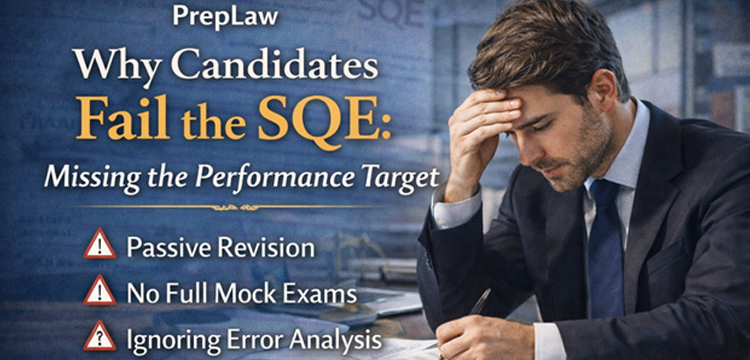
The Solicitors Qualifying Examination UK is not just a knowledge test. It is a performance exam. Every year, capable candidates struggle not because they lack intelligence, but because they misunderstand how the assessment works.
At PrepLaw, we see the same pattern repeatedly: students revise heavily, read multiple textbooks, highlight endless notes and then underperform in the real exam.
This article explains why.
The Real Challenge of SQE1
The SQE1 and SQE2 exams assess different skills. SQE1 focuses on Functioning Legal Knowledge (FLK) through multiple-choice questions that test applied reasoning.
The difficulty is not memorising rules. The challenge is selecting the single best answer when several options appear correct.
Many candidates preparing for the SQ1 exam assume it resembles university exams. It does not. It is closer to a high-level professional reasoning test than an academic essay assessment.
The Three Biggest Mistakes Candidates Make
Passive Revision Instead of Applied Practice
Reading an SQE book repeatedly feels productive. But without active problem-solving, knowledge remains theoretical.
Effective exam study requires:
- Daily applied questions
- Timed practice blocks
- Regular mock simulations
Practice must mirror exam conditions.
Avoiding Full-Length Mock Exams
Some students attempt topic-based questions but avoid full practice mock exams because they feel intimidating.
That is precisely why they are necessary.
A proper law online exam simulation builds:
- Mental stamina
- Time management
- Emotional control under pressure
If you are not regularly testing yourself under timed conditions, you are not fully preparing.
Ignoring Error Analysis
Taking a mock is only half the work. Improvement happens during review.
After each mock, ask:
- Why did I choose the wrong answer?
- Did I misread the facts?
- Did I misunderstand the legal principle?
- Was I rushing?
Performance tracking transforms random practice into strategic improvement.
Is SQE Hard? Yes, But It Is Predictable
Many candidates ask, “How hard is SQE?”
It is demanding because it tests:
- Breadth of knowledge
- Precision
- Consistency across hundreds of questions
However, it is not unpredictable. Patterns repeat. Certain topics are heavily tested. Time pressure is constant.
Structured preparation makes the difficulty manageable.
Building a Winning PrepLaw Strategy
To maximise performance:
Step 1: Structured Weekly Plan
- Two focused revision blocks per FLK subject
- Three timed question sessions
- One full mock every 10–14 days
Step 2: Track Your Metrics
- Accuracy percentage
- Time per question
- Weak subject areas
Step 3: Rotate Topics
Do not over-focus on strengths. The SQE tests everything.
Preparing for SQE2 Early
Although this article focuses on SQE1, remember that SQE2 assesses practical skills such as drafting, advocacy and interviewing.
Strong analytical foundations in SQE1 will directly improve SQE2 performance later.
The PrepLaw Philosophy
Success in the SQE is not about cramming. It is about:
- Structured law prep
- Consistent mock performance
- Honest error review
- Gradual performance improvement
Preparation without measurement is guesswork.
Practice with analysis is progress.
The SQE does not reward the candidate who studies the longest. It rewards the candidate who studies the smartest.
If you want to pass and pass confidently treat every practice session as exam rehearsal.